

The goldfish experiment that proves Tucker Carlson wrong
How the Allee Effect explains why birds flock, fish school, and newcomers improve economies

A couple weeks ago, the New York Times featured everyone’s favorite pouty right-wing commentator Tucker Carlson on its popular weekend podcast show, The Interview, in which they delve into the thoughts and feelings of powerful people in culture and politics, no matter how antisocially toxic they may be. In it, Carlson makes a seemingly common-sensical argument about why immigration should be shut down immediately. Here’s the 90-second clip:
This argument seemed so obviously true that the New York Times’ interviewer Lulu Garcia-Navarro let it pass, uncontested.
What Carlson fans and the New York Times audience needs to know, however, is that in fact this argument is wholly wrong—and an experiment on goldfish explains why.
More on that, below.
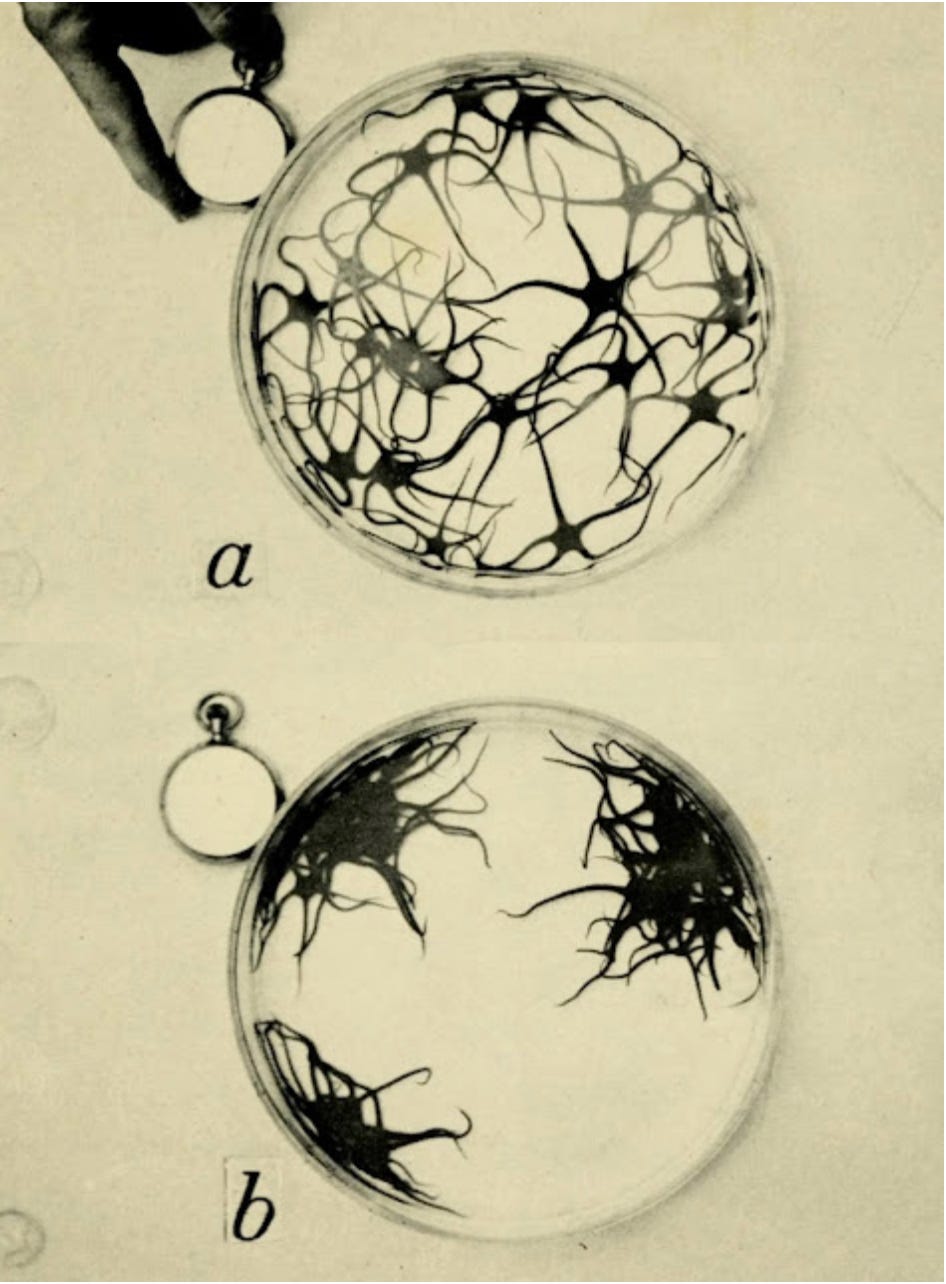
Brittle Stars (Ophiuroidea) who have just been dropped into sea water (top) and after ten minutes have passed (bottom) From The Social Life of Animals by Warder Clyde Allee (1938)
Warder Clyde Allee, an early twentieth century Quaker biologist who worked at the Marine Biological Laboratory in Woods Hole, MA, spent many hours walking along the beaches of Cape Cod collecting sea creatures. The sea stars he found in the beds of eel grass always appeared in clumps, rather than alone. He dropped them into his glass-bottomed bucket, in which they similarly clumped together in a dense mass, rather than spreading out.
It struck him as counterintuitive: according to the conventional wisdom, being in a group forces individuals to compete with others for limited resources, degrading their ability to survive. This drive to avoid group competition was why Americans spread out of the cities into suburban sprawl and shaped any number of aspects of modern life. There was plenty of room in the bucket and along the beds of eel grass for the fish and the snakes to spread out. And yet they opted to cozy up together. Why?
Allee started to conduct experiments measuring how individuals fared when in groups compared to as individuals. And what he found is that the clumps of sea stars were doing something that makes sense.
A lone goldfish, for example, deposited into poisoned water will survive for just 182 minutes, Allee found, compared to a group of goldfish deposited into the same poisoned water, each of which will survive for 507 minutes. A worm or a sea star facing a zap of UV radiation alone will die 1.5 times faster than worms or sea stars who clumped together with others in a group. A baby frog or sea urchin will develop into a capable adult more quickly if they have more siblings rather than fewer siblings around them. Group living appeared so critical to survival, Allee found, that if groups got too small, individuals would actually start to die off. Below a certain population density, tse tse flies start to spontaneously disappear, for example, as if starved for company.
The invisible gifts of group life, Allee realized, explained why his sea stars clumped in his glass-bottomed bucket, even when they could spread out. It explained a whole range of otherwise mysterious behaviors, such as why fish schooled in the sea, why birds flocked, why caribou and other mammals grouped together in herds, and why immigrants lived close by each other, forming immigrant neighborhoods. Competition was only half the story. Being part of a group enhanced an individual’s ability to flourish, too.
For decades, nobody followed up much on Allee’s findings. Discoveries about the biological benefits of collective living did not align well with the zeitgeist of his era. Locked in an existential Cold War with the Soviet Union, early twentieth century American institutions were much more concerned with touting the benefits of rugged individualism and the free market than the collectivism of the Soviet Union’s communist system. Allee’s concept was “not much embraced by the wider ecological community,” the authors of a 2008 book on the biologist note. For decades, scientists focused instead on “classical negative density dependence,” that is, the perils of crowds. Adding more individuals to groups, they insisted, means more competition for scarce resources—and the ultimate degradation and suffering of all.
Plagued with too many mouths to feed, the dystopic society in the 1973 film Soylent Green feeds the masses with a titular green wafer of mysterious provenance, as Charlton Heston explains in this clip.
The toxicity of the crowd was first articulated by the English cleric and demographer Thomas Robert Malthus in the late 18th century. Influential scientists resuscitated and expanded the Malthusian case against crowds during the so-called “overpopulation crisis” of the 1970s, when postwar mortality rates dropped due to the introduction of antibiotics and other medical advances while birth rates continued to climb.
The biologist Paul Ehrlich sensed an impending catastrophe. In best-selling books, he wrote expansively about the pathological horror of life in crowds. Growing postwar populations competing for scarce resources would inexorably lead to the “utter breakdown of the capacity of the planet to support humanity,” he wrote in his 1968 bestseller The Population Bomb. (It was a “P bomb” to rival the A bomb.) The ethologist John B Calhoun demonstrated the toxicity of crowds in microcosm, stuffing rats into a quarter-acre enclosure behind a neighbor’s house and watching them descend into cannibalism, infanticide and worse. A 1973 film starring Charlton Heston depicted American cities so overrun with crowds of people that they were forced to feed the masses with mysterious rations of the titular Soylent Green, a crunchy green wafer secretly made from human bodies.
Back then—just as today—social panic about the toxicity of crowds led to muscular demands for an end to immigration. Ehrlich said starving Indians would flood the country and “overwhelm us in order to get what they consider to be their fair share.” The sociologist Kingsley Davis said California should close its borders to immigrants from China and Mexico. The ecologist Garrett Hardin said that wealthy nations had to close their borders or risk being swamped like a precarious lifeboat subjected to hordes of people clambering aboard.
I write much more about this in “Malthus’ Hideous Blasphemy,” which appears as Chapter Six in my 2020 book, The Next Great Migration. Suffice it to say here that the 1970s social panic over population growth led directly to the establishment of the modern anti-immigration movement. Ehrlich’s group, Zero Population Growth, attracted the involvement of the opthalmologist John Tanton, who’d go on to found some of today’s most powerful anti-immigrant organizations.
But they all were wrong. None of the biological catastrophes they worried about and upon which their theories were based came to pass.
The phenomenon that Allee discovered inside that glass bottomed bucket—now known as Allee effects—foiled them all.

Digital rendition of M.C. Escher’s Sky and Water I by ArtImpresia
It’s not just one thing that makes togetherness better. The Allee effect comes true due to a variety of mechanisms.
In the case of fish in poisoned water, it’s that the protective chemicals that each individual secretes reaches a concentration that is actually effective for all. In other cases, larger groups make finding mates easier; it makes an individual’s modifications to a shared habitat which would otherwise make little difference become actually impactful. It makes it possible for individuals to take defensive measures, such as when a single alarm call by a lone individual gets amplified by the voices of many rather than just one, allowing more individuals to hear it and protect themselves.
In the case of humans, bigger groups means not only more mouths to feed, but more hands to work and minds to dream. Bigger groups of Homo sapiens make possible new ways of doing things, which can then expand opportunities for all individuals in the group. It’s why densely packed cities are engines of innovation and why the addition of new immigrants adds to the economy over time. More people living together can even lead to declines in birth rates, as for example when population growth in places like India and China led to increased prosperity which led to more education for women which led them to have fewer babies.
Paul Ehrlich worried that population growth would lead to famine in Mexico and worsen smog in California. Nope. Just the opposite happened. More people in Mexico translated into the development of new ways of growing food; the population grew and the food supply expanded. More people in California led to catalytic converters and emissions regulations that lifted the smog; the state population grew and smog pollution diminished. The Allee effect even happened inside the enclosure crowded with seemingly depraved rats, who innovated new ways of building burrows (inspiring the National Geographic writer Robert C. O’Brien to write one of my favorite children’s books, Mrs. Frisby and the Rats of NIMH.)
The Allee effect—now “unambiguously” proven in “an impressive range of taxa and ecosystems,” as one Allee biographer put it—defies simplistic notions about populations facing scarcity. It shows that the benefits of togetherness can outweigh the negatives of competition. If so, as job-killing AI spreads, the US economy might need more newcomers to bring their new ideas and novel methods in order to survive, not fewer. Tucker Carlson, in other words, could be precisely wrong.
Allee effects in other animals are now widely embraced by biologists and conservationists, who are currently preoccupied with the problems of shrinking animal populations. But as with many areas of life, what we understand and accept in other animals we reject in our own. In the case of humans, the same old and invalidated arguments that ignore the Allee effect continue to make the rounds on major platforms, uncontested.

Learnt something new today. Thank you for continuing to teach your readers. The Allee effect was completely new to me, and the way you used it to reframe such a polarized topic was really refreshing. I appreciate how you step around the ideological noise, bring in science, and show how the “common‑sense” argument can actually be the wrong one. Still letting it sink in (especially since the rat experiment is scientific too and the topic is complex and I need to contemplate), but your perspective here is genuinely enlightening.
I love this! It is another indicator that cooperation is a biological precedent. Competition and conflict is a part of the human experience. Part of this is related to tribal tendencies and fear of the other. But part of this ideology also stems from mythology and misrepresentation of individualism. Individuality is one thing, but the mistaken identity of the rugged individual is good for propaganda and anti-communist sentiments, but it creates significant isolation.
Thank you for writing! I look forward to reading more!